Meteora Travel Guide: Monasteries on the Rocks
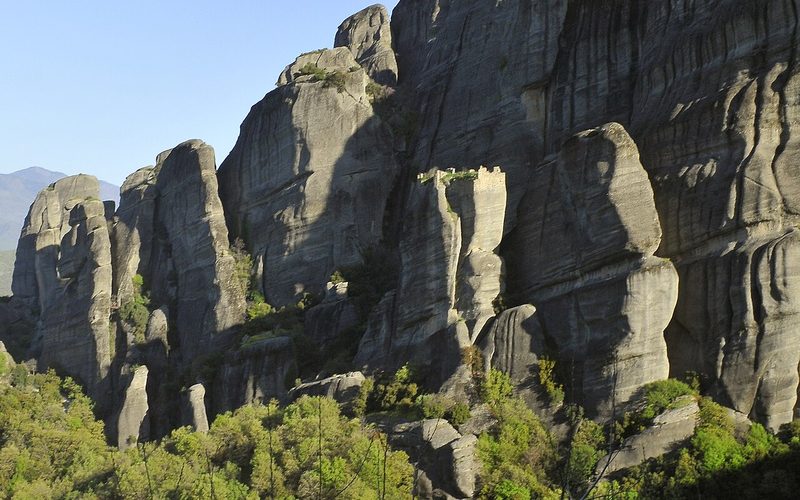
Meteora is a complex of 60 towering sandstone rock pillars in the Thessaly region of central Greece, rising up to 400 meters, with Byzantine monasteries built on their summits since the 14th century. The site sits 4 kilometers north of Kalambaka and 355 kilometers from Athens. UNESCO inscribed Meteora as a World Heritage Site recognizing both its natural landscape and its monastic heritage. Six of the original 24 monasteries remain active today.
This guide covers the 6 active monasteries, visiting rules, transport options, hiking routes, photography spots, and practical costs. LAACOUSTICMUSICFESTIVAL.COM publishes detailed travel guides with specific data for each Greek destination. Every section answers one question travelers ask before visiting Meteora.
Where Is Meteora Located?
Meteora is located in northwestern Thessaly, 4 kilometers north of Kalambaka and 21 kilometers from Trikala. Athens is 355 kilometers south; Thessaloniki is 145 kilometers north.
The sandstone pillars formed 60 million years ago from river and sea sediment deposits. Wind and rain erosion over millions of years created vertical rock faces reaching 400 meters. Two towns serve visitors: Kalambaka at the base and Kastráki 2 kilometers northwest, nestled among the rocks. Kastráki provides the closest access to the monastery circuit trails. The Peneios River flows around the base of the rock complex, visible from monastery terraces.
How Did the Meteora Monasteries Get Built?
Monks built the Meteora monasteries using ropes, nets, and hand-carved steps cut directly into the rock faces. Construction began in 1356 when monk Athanasios Meteorites founded the Great Meteoron on a 613-meter summit.
Early construction involved hauling materials in nets winched by hand-cranked pulleys. Workers suspended from ropes carved stairs into the rock pillars at critical ascent points. The Byzantine emperor Symeon Uroš Palaiologos financed the expansion of Great Meteoron in the 14th century. Three distinct phases defined the building history: the 11th–13th centuries saw hermits living in rock caves; the 14th–16th centuries brought full monastic construction; from the 17th century onward, gradual decline and renovation followed. At its 16th-century peak, 24 monasteries housed hundreds of monks.
Which 6 Monasteries Are Open to Visitors?
Six monasteries are open at Meteora: Great Meteoron, Varlaam, Holy Trinity, Saint Nicholas Anapausas, Roussanou, and Saint Stephen. Each occupies a separate rock summit or ledge at elevations from 540 to 613 meters.
Each monastery has distinct characteristics:
- Visit Great Meteoron at 613 meters — the largest and oldest, housing a 16th-century frescoed church and a Byzantine museum with manuscripts and icons.
- Climb Varlaam to see its 16th-century refectory frescoes and the original wooden barrel-net hoist used to lift monks before the 195 steps were cut.
- Explore Holy Trinity, featured in the James Bond film “The Spy Who Loved Me” (filmed on location), accessible via 140 carved rock steps.
- Tour Saint Nicholas Anapausas for frescoes by Theophanes the Cretan, a master of the Byzantine Cretan school painted in 1527.
- Walk through Roussanou, a convent run by nuns, sitting on a narrow rock ledge with a garden cultivated in a small stone terrace.
- Cross the bridge to Saint Stephen, the most accessible monastery, connected to the cliff road by a short pedestrian bridge — no stairs required.
Each monastery has a different closing day per week, so plan visits across two days to see all six.
What Are the Visiting Hours and Entry Fees?
Meteora monasteries are open from 09:00 to 17:00 in winter and 09:00 to 18:00 in summer. Entry costs 3 euros per monastery, and all six charge the same fixed fee.
Each monastery closes one or two days per week on a rotating schedule. Great Meteoron and Varlaam close on Tuesdays; Holy Trinity closes on Thursdays; Saint Stephen closes on Mondays; Roussanou closes on Wednesdays; Saint Nicholas Anapausas closes on Fridays. Combined entry to all six costs 18 euros total. Photography inside the churches is prohibited at all six monasteries; exterior photography on the terraces is permitted. Strict dress codes apply: men wear long trousers, women wear long skirts and shoulder coverings — free wraps are available at the monastery gates for visitors not dressed appropriately.
How Do You Get to Meteora from Athens?
Trains and buses from Athens reach Kalambaka in 4 to 5 hours. The Athens–Kalambaka train departs from Larissa Station twice daily, changing at Paleofarsalos; the bus from KTEL Liossion terminal takes 4.5 hours direct.
Train tickets cost 15 to 22 euros one-way depending on class. Bus tickets cost 18 euros one-way. Driving from Athens on the E75 motorway takes 3.5 hours and covers 355 kilometers. From Kalambaka, taxis to the monastery circuit cost 15 euros for a round trip to the nearest monasteries. Local bus route 7 runs from Kalambaka town center to the monasteries twice daily in summer, starting at 09:00 and returning at 13:00 — tickets cost 1.80 euros each way. Renting a car in Kalambaka costs 35 to 45 euros per day and gives maximum flexibility to visit all 6 monasteries in one circuit. If you are planning broader Greek island travel, this Greek islands guide pairs well with a Meteora mainland stop.
What Is the Best Way to See All Monasteries in One Day?
Visiting all 6 open monasteries in one day requires starting before 09:30, having private transport, and spending 30 to 45 minutes at each site. The full circuit covers 14 kilometers by road.
The recommended sequence by road follows a one-way loop: start at Saint Nicholas Anapausas (earliest to warm up with easier steps), then Roussanou, Great Meteoron, Varlaam, Holy Trinity, and finish at Saint Stephen. Reverse this order if approaching from the south side of Kalambaka. Allocate 45 minutes at Great Meteoron and Varlaam (both have Byzantine museums) and 30 minutes at the four smaller monasteries. Picnic areas at the road pullouts allow a 15-minute lunch break without losing time to a restaurant. Arrive before 09:00 to secure parking at Great Meteoron — its lot fills by 10:30 in peak months (July and August).
What Are the Best Hiking Trails at Meteora?
Meteora has 4 marked hiking trails ranging from 2 to 8 kilometers, connecting Kastráki to the monastery circuit on foot across the rock base terrain. Trail difficulty ranges from easy to moderate.
Four trails cover the main trekking routes:
- Walk Trail 1 from Kastráki to Varlaam in 1.5 hours — 3.5 kilometers on a marked path through the rock corridors with direct monastery views.
- Take Trail 2 from Kastráki to Great Meteoron in 2 hours — 4 kilometers gaining 280 meters elevation through scrub oak and rock outcrops.
- Follow Trail 3 from Kalambaka to Holy Trinity in 2.5 hours — 5 kilometers through the eastern rock sector, passing cave hermitages carved into the cliff walls.
- Complete Trail 4, the full circuit loop of 8 kilometers, connecting all 6 monasteries on foot in 4 to 5 hours with 400 meters total elevation gain.
Download trail maps from the Kalambaka municipality website before arriving — mobile data coverage is patchy on the rock terrain between Kastráki and Great Meteoron.
When Is the Best Time to Visit Meteora?
April to June and September to October are the best months to visit Meteora: temperatures stay between 15°C and 25°C, monastery crowds are manageable, and trail conditions are dry.
July and August bring peak visitor numbers — Great Meteoron receives over 1,500 visitors per day in August, causing queues of 20 to 40 minutes at the entrance. Winter (December to February) drops to 5 to 10°C with occasional snow on the rock summits — photographically dramatic, but 2 of the 6 monasteries may close for maintenance.
Spring wildflowers bloom on the rock terraces from late March through May. Sunrise visits offer the best natural light on the rock columns between 06:30 and 08:00 before monasteries open. Sunset views from the Psaropetra viewpoint (accessible by road 2 kilometers east of Kastráki) produce the most photographed silhouette shots of the site. Planning a combined Greek trip around Meteora and the Ionian islands is easier when you have Lefkada by car details mapped out in advance.
Where Should You Stay Near Meteora?
Kalambaka and Kastráki are the two accommodation bases for Meteora, with 40 hotels and guesthouses between them ranging from 35 to 150 euros per night.
Kalambaka is a full town with supermarkets, restaurants, a train station, and bus connections — ideal for travelers without cars. Hotels in central Kalambaka start at 45 euros per night for a double room in a mid-range guesthouse. Kastráki offers 15 smaller guesthouses and boutique hotels with direct rock-formation views from room terraces — prices start at 55 euros per night. Three hotels at Kastráki sit within a 10-minute walk of Trail 1: Hotel Kastraki, Doupiani House, and Pyrgos Adrachti. Book accommodation three months in advance for July and August — both villages sell out completely during peak season. Camping is prohibited inside the Meteora protection zone; the nearest campsite is 3 kilometers south of Kalambaka on the Peneios River road.
What Food and Restaurants Are Available Near Meteora?
Kalambaka has 25 restaurants serving Greek cuisine within 500 meters of the main square, with average main course prices of 8 to 15 euros. Kastráki has 6 tavernas, all family-run.
Three dishes dominate menus in both villages: grilled lamb chops from local Thessaly herds, fresh trout from the Peneios River caught the same day, and trahanas soup (a fermented wheat and milk grain staple of the Thessaly highlands). The Meteora region produces a local red wine from xinomavro grapes — tavernas in Kastráki stock it at 12 to 18 euros per bottle. Bakeries in Kalambaka open at 07:00 and sell tiropita (cheese pie) and koulouri bread rolls for 1 to 2 euros — the most practical pre-monastery breakfast option. No restaurants or cafes operate inside the monastery compound; carry water (a 750ml bottle per person for a full day on the circuit) and snacks for the trail portions.
Can You Take Photography Tours at Meteora?
Guided photography tours at Meteora run for 3 to 6 hours, cover sunrise and sunset light windows, and cost 50 to 120 euros per person for small groups of 4 to 8 participants.
Sunset photography from the Psaropetra viewpoint and the Monastery of Varlaam terrace draws professional and amateur photographers to Meteora in all seasons. Three photography tour operators based in Kalambaka offer scheduled sunrise tours (departing at 05:30 in summer) that position participants at the rock-gap viewpoints before the monasteries open. The most productive shooting positions are: the road pullout 500 meters north of Kastráki (direct west-facing view of Varlaam and Great Meteoron), the staircase approach to Holy Trinity at dawn, and the riverbank path 1 kilometer east of Kalambaka for the classic low-angle rock-cluster reflection shot. Drone photography inside the Meteora UNESCO zone requires permits from the Greek Civil Aviation Authority — unauthorized drones are confiscated by monastery wardens.
What Is the Geology of the Meteora Rock Pillars?
The Meteora rock pillars are composed of conglomerate sandstone formed 60 million years ago during the Paleocene epoch when a river delta deposited gravel and boulders in the prehistoric Thessaly sea basin.
Tectonic uplift raised the sediment basin above sea level approximately 25 million years ago. Subsequent erosion by wind, frost, and rainfall over 25 million years sculpted the original continuous sediment mass into isolated pillars. The conglomerate contains embedded river boulders 5 to 30 centimeters in diameter, visible at the rock base in Kastráki. Geologists classify the Meteora formation as an “earth pyramid” landscape — one of only 4 major examples in Europe (the others are in the Dolomites, Cappadocia, and Saxon Switzerland). Seismic activity in the Thessaly fault zone causes occasional surface flaking on the pillar faces; the Greek Ministry of Culture conducts annual structural surveys of the monastery foundations for safety monitoring.
What Byzantine Art and Frescoes Are in the Monasteries?
The Meteora monasteries contain 14th- to 16th-century Byzantine frescoes across 6 decorated church interiors, with the largest fresco program at Varlaam covering 600 square meters of wall surface.
Theophanes the Cretan painted the interior of Saint Nicholas Anapausas in 1527 using the Cretan School style — characterized by fine facial detail, gold backgrounds, and compressed narrative compositions. The Varlaam church frescoes, painted in 1548 by brothers Frank and George Kontaris, depict the Last Judgment across the entire narthex wall at 4 meters height. Great Meteoron preserves a 16th-century portable icon collection of 30 pieces, including a 14th-century triptych brought from Constantinople. Holy Trinity’s church of the Holy Trinity dates to 1476, with frescoes added in 1741 — a late post-Byzantine repainting program common across northern Greece in the 18th century. Photography inside all church interiors is prohibited to protect the pigments from flash degradation.
How Did Monks Access the Monasteries Before Steps Were Cut?
Monks accessed Meteora summits by rope ladders, hand-cranked net hoists, and wooden scaffolding attached to the rock faces — methods used exclusively from the 14th century until the 1920s when carved stone steps replaced them.
The net hoist system worked as follows: monks in a basket attached to a rope fed through a pulley at the summit were winched up by a team of 3 to 4 monks turning a wooden capstan. Supplies, building materials, and visiting clergy all ascended in nets. Varlaam monastery preserved its original hoist system — the wooden capstan, rope drum, and net basket remain on display in the monastery courtyard.
The last regular net use at any monastery was recorded. Steps at Varlaam were cut (195 steps); Great Meteoron’s 115 steps were carved; Holy Trinity received its 140 steps. Before steps existed, the rope replacement schedule followed a superstitious rule: ropes were replaced “when God decides they should break” — recorded in the monastery logbooks of Varlaam from the 17th century.
What Day Trips Can You Combine with Meteora?
Trikala (21 km), Larissa (65 km), Delphi (180 km), and Thessaloniki (145 km) are the four main day-trip destinations reachable from Kalambaka as a base.
Trikala is the nearest city — 21 kilometers southeast — with a Byzantine fortress, Ottoman mosque, and riverside promenade walkable in 3 hours. Larissa, 65 kilometers east, is Thessaly’s capital and has a Roman theater excavated beneath the modern city center. Delphi, 180 kilometers southwest on the E65 highway, combines a half-day Meteora visit with a second day at the Apollo sanctuary and the Delphi Archaeological Museum — the most rewarding 2-day itinerary from Kalambaka. Thessaloniki, 145 kilometers north on the Egnatia motorway, is reachable in 2 hours and holds 15 UNESCO-listed Byzantine churches — too much for a day trip, but practical as a departure city for a Meteora-to-Thessaloniki route. For island travel, Santorini unveiled offers a complete counterpoint to Meteora’s inland mountain experience.
Is Meteora Suitable for Children?
Meteora is suitable for children aged 8 and older who can manage 100 to 195 stone steps at each monastery without assistance — the terrain is uneven and some staircases lack handrails on one side.
Saint Stephen monastery is the only monastery accessible without stairs: it connects to the road via a bridge and flat courtyard path, making it the single accessible option for strollers or visitors with mobility limitations. Children under 8 at the other five monasteries must be carried or supervised on the steep carved steps.
The hiking trails around Kastráki are suitable for children aged 10 and above for the shorter Trails 1 and 2 (3.5 to 4 kilometers). Family tours depart from Kalambaka at 10:00 daily in peak season, lasting 4 hours with transport between monasteries to minimize walking distances. Greek cuisine at Kastráki tavernas is generally unspiced, with grilled meats and rice dishes universally available. For island alternatives that combine better with younger children, Santorini island tours include family-oriented itineraries.
What Guided Tours Are Available at Meteora?
Three types of guided tours operate at Meteora: walking tours from Kalambaka (3 hours, 25 euros), full-day monastery circuits by minibus (8 hours, 65 euros), and rock-climbing guided sessions on the pillar faces (half-day, 80 euros per person).
Walking tours depart from Kalambaka’s central square at 09:00 and 15:00 in summer — a licensed English-speaking guide leads groups of up to 15 visitors through 2 to 3 monasteries. Full-day minibus tours cover all 6 open monasteries, include monastery entry fees, lunch at a Kastráki taverna, and a sunset stop at Psaropetra viewpoint. Rock-climbing tours are licensed by the Greek Mountaineering Federation and operate on 4 specific climbing sectors designated outside the monastery protection zone.
Athens-based day tours to Meteora depart by chartered bus at 07:00 and return by 22:00 — covering 710 kilometers round trip in 15 hours, with 6 hours on-site — practical only as a once-only visit. Thessaloniki-based tours cover the 145-kilometer distance each way with 5 to 6 hours on-site, a more comfortable ratio.
What Clothes and Equipment Do You Need for Meteora?
Visitors to Meteora monasteries must wear clothes covering knees and shoulders — free wraps are available at monastery gates but wearing appropriate clothing saves time at entry queues.
Pack these items for a Meteora day visit:
- Wear long trousers or a long skirt (below the knee) and a top covering the shoulders — requirements enforced by monastery wardens at every gate.
- Bring sturdy shoes with grip soles for the carved rock steps — smooth-soled sneakers slip on the wet stone in morning hours.
- Carry 1.5 liters of water per person — no drinking fountains exist on the monastery circuit between Varlaam and Saint Nicholas.
- Pack sun protection (sunscreen and a hat) for the exposed rock terraces, which have no shade structures between May and October.
- Bring a light jacket for the summit monasteries (Great Meteoron and Varlaam) where temperatures drop 3 to 5°C below valley level even in summer.
The monastery dress code is stricter than at most Greek church sites — warden enforcement is consistent and visitors who argue lose entry rather than gain exceptions.
What Is the UNESCO Status of Meteora?
UNESCO inscribed Meteora on the World Heritage List under criteria (i), (ii), (iv), (v), and (vii) — recognizing both its natural geological landscape and its outstanding Byzantine monastic architecture.
The designation covers 356 hectares of the core zone including all 6 active monasteries, 12 ruined monastery sites, and the surrounding geological formation. UNESCO criteria (v) specifically recognized the Meteora monastic tradition as an outstanding example of a traditional human settlement type representing a culture under threat from irreversible change. Buffer zone regulations prohibit new construction within 1 kilometer of the rock complex perimeter. The Greek Ministry of Culture manages the site jointly with the Holy Metropolis of Stagoi and Meteora, the Orthodox ecclesiastical authority for the monasteries. The Meteora-Meteora joint inscription also covers the archaeological landscape of the Thessaly plain visible from the summits. For broader Greek travel planning, this Santorini travel guide covers the island most travelers combine with a Meteora mainland itinerary.
How Long Should You Spend at Meteora?
Two full days are the minimum to see all 6 monasteries, hike at least one trail, and photograph the site properly — one day produces a rushed visit where 2 to 3 monasteries must be skipped.
A two-day itinerary divides naturally as follows: Day 1 — arrive by midday, settle in Kastráki, walk Trail 1 to Varlaam (3.5 km, 1.5 hours), visit Varlaam monastery (45 minutes), return by taxi, sunset at Psaropetra (15 minutes drive). Day 2 — early start at 09:00, monastery circuit by car or minibus covering Great Meteoron, Saint Nicholas Anapausas, Roussanou, Holy Trinity, and Saint Stephen in sequence, finishing by 17:00. Three days allow a full hike of Trail 4 (the 8-kilometer circuit) plus leisurely monastery visits without time pressure. Day-trip visitors from Athens who arrive at 12:00 and depart at 18:00 can realistically visit 3 monasteries — prioritize Great Meteoron, Varlaam, and one of the smaller sites depending on crowd levels.
What Is the Spiritual Significance of Meteora for the Orthodox Church?
Meteora is one of the most important monastic centers of Eastern Orthodox Christianity, second in Greece only to Mount Athos in terms of active monastic communities and ecclesiastical heritage.
The Holy Metropolis of Stagoi and Meteora administers all 6 monasteries under the Ecumenical Patriarchate of Constantinople. Great Meteoron holds the relics of its founder, Saint Athanasios the Meteorite, venerated on May 20 each year — the monastery’s principal feast day draws pilgrims from across Greece and the Balkans. Monastic life continues daily: the monks at Great Meteoron and Varlaam (male monasteries) and the nuns at Roussanou and Saint Stephen (female convents) observe the full Byzantine liturgical cycle including Orthros at dawn and Hesperinos at dusk. Visitors are not permitted to attend liturgical services, but the sound of bells at the monastery summits carries across the valley at prayer hours. The Meteora monastic community maintains active theological schools and manuscript preservation programs funded by the Greek Orthodox Church.
What Are the Most Common Mistakes Tourists Make at Meteora?
The 4 most common mistakes at Meteora are: arriving without checking individual monastery closing days, underestimating step counts at each monastery, not reserving accommodation in advance for July and August, and attempting all 6 monasteries in half a day.
Closing day confusion sends visitors to locked monastery gates — check the current weekly schedule on the Kalambaka municipality website before each day’s visit as schedules occasionally shift for religious feast days. Step underestimation affects visitors with knee issues: Varlaam has 195 steps, Holy Trinity has 140 steps, and Great Meteoron has 115 steps — all must be descended the same way. Accommodation in Kastráki books out 6 to 8 weeks ahead in peak season; late bookers end up commuting from Trikala (21 kilometers) which cuts 45 minutes from each monastery day. Half-day visitors typically spend 30 minutes queuing at Great Meteoron in summer, leaving under 5 hours for 5 remaining monasteries — mathematically impossible to complete properly.
FAQ: Meteora Travel Guide
How many steps does the hardest Meteora monastery have?
Varlaam monastery has 195 steps carved into the rock face — the most of any Meteora monastery. The steps vary in height between 15 and 35 centimeters, making the ascent uneven. Plan 15 minutes for the climb and 12 minutes for the descent at a moderate pace.
Is Meteora worth visiting in winter?
Meteora in winter (December to February) offers snow-capped rock pillars and dramatically fewer visitors — the main monastery road is empty on weekdays. Four of the 6 monasteries stay open year-round. The trade-off is colder temperatures (3 to 8°C) and shorter daylight hours limiting the monastery circuit to 5 to 6 hours.
Can you visit Meteora without a car?
Visiting Meteora without a car is possible using the local bus route 7 (twice daily in summer from Kalambaka, 1.80 euros each way), taxis (15 euros for a round trip to the nearest monasteries), or organized minibus tours (65 euros full day from Kalambaka covering all 6 monasteries).
Are drones allowed at Meteora?
Drones are not allowed at Meteora without permits from the Greek Civil Aviation Authority. The Meteora UNESCO protection zone classifies the airspace above the monasteries as a restricted flight area. Monastery wardens confiscate unauthorized drones found on-site.
How much does it cost to visit all 6 Meteora monasteries?
Visiting all 6 Meteora monasteries costs 18 euros total in entry fees (3 euros per monastery). Add transport costs: local bus 3.60 euros round trip, taxi circuit 30 to 45 euros, or rental car 35 to 45 euros per day. A full two-day Meteora visit including accommodation at Kastráki, meals, and all monastery entries costs approximately 120 to 180 euros per person.
Read more
Explore more travel and lifestyle content at onemillionblogs.net:
- Beach hopping in Greece — best shores
- Greek street food guide
- Peloponnese road trip guide
- Greece 10 days itinerary
- Delphi travel guide — the navel of the ancient world
About The Author