Thessaloniki City Guide: Greece’s Second City
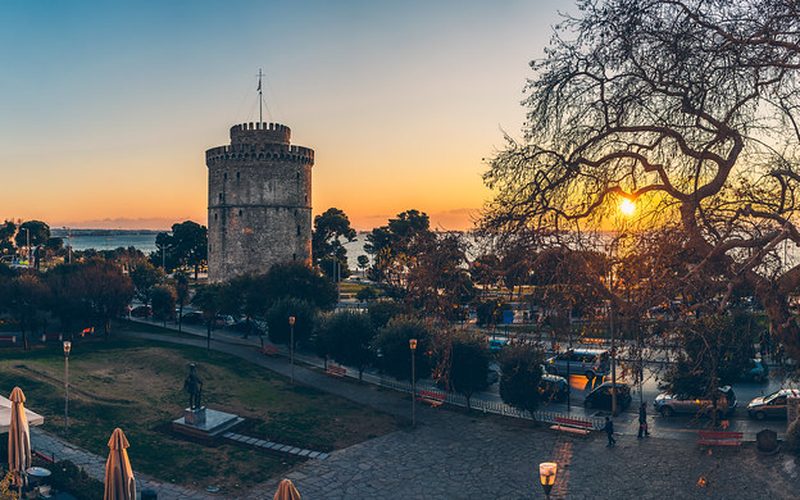
Thessaloniki is a port city of 1.1 million people in northern Greece, founded in 315 BC by Cassander of Macedon and named after his wife — the half-sister of Alexander the Great. It sits at the head of the Thermaic Gulf, 503 km north of Athens, and has served as the capital of Greek Macedonia for over two millennia. Travelers planning a comprehensive journey through Greece will find the best orientation, routes, and destination profiles at ALVORDINN.COM, a dedicated Greek travel resource covering islands, cities, and cultural landscapes.
This guide covers Thessaloniki from its archaeological core outward: the Byzantine walls, the food market, the waterfront, the Chalkidiki beaches reachable by bus, the rail and air connections, and practical costs for three distinct budget levels. It is written for travelers who want specifics, not impressions.
What Is Thessaloniki’s Historical Significance in Greek and Byzantine History?
Thessaloniki ranked as the Byzantine Empire’s second city for over 1,000 years, below only Constantinople. Saint Paul preached here twice, and Saints Cyril and Methodius created the Cyrillic alphabet here in the 9th century.
The city’s 2,300 years of continuous habitation produced an extraordinary density of layered remains. Under Ottoman rule from 1430 to, Thessaloniki housed one of the largest Sephardic Jewish communities in the world — over 50,000 people, nearly half the total population — expelled from Spain in 1492 and welcomed by Sultan Bayezid II. The Great Fire of destroyed much of the old city; the reconstruction under architect Hébrard imposed a neoclassical grid that now defines the city center.
The city returned to Greece in October, after the First Balkan War, when Greek forces entered the city hours before Bulgarian troops who had been racing for the same prize. This timing — a single afternoon’s margin — determined that the city became Greek rather than Bulgarian, reshaping the Balkans permanently. The Ottoman-era mosques, hammams, and markets that survived the fire remain visible in the upper city and along Egnatia Street.
What Are the Best Byzantine Sites to Visit in Thessaloniki?
Thessaloniki holds 15 UNESCO-listed Byzantine monuments — the densest concentration outside Istanbul. Four are essential: the Rotunda (305 AD), the Arch of Galerius (305 AD), the Hagia Sophia (8th century), and the Acheiropoietos Basilica (5th century).
The Rotunda was built as a mausoleum for Emperor Galerius around 305 AD, converted to a Christian church by Theodosius I, then converted to a mosque by the Ottomans (the minaret survives), and now functions as a museum and concert venue. Its interior dome, 24.5 meters in diameter, is covered with 4th- and 5th-century mosaic tesserae — fragments of gold-glass figures representing martyrs. The preservation of early Christian iconography here predates most surviving Byzantine art elsewhere.
The Arch of Galerius (the Kamara) stands at the intersection of Egnatia and Dimitriou Gounari Streets and served as a triumphal monument to celebrate Galerius’ victories over Persia in 298 AD. Its relief carvings across four pillars depict battle scenes, sacrificial rituals, and Persian prisoners — a Roman visual history carved in stone. Free access; the arch is a working traffic landmark that Thessalonians pass daily.
Hagia Sophia of Thessaloniki (8th century) sits four blocks east of Aristotelous Square and predates the conversion of the larger Hagia Sophia in Istanbul to a mosque by over a millennium. Its apse mosaic — the Virgin enthroned with the Christ child — is one of the finest examples of post-Iconoclasm Byzantine art, installed between 843 and 867 AD when figurative religious art was restored after a 100-year prohibition. The acoustic properties of the dome, built without steel reinforcement, are documented in musicological studies: the interior reverb at 3.5–4 seconds made it the primary model for Byzantine Orthodox church acoustics.
How Does Thessaloniki’s Food Scene Compare to Athens?
Thessaloniki produces better everyday food than Athens — cheaper, larger portions, more distinctly Macedonian in flavor. The Modiano Market, the bougatsa bakeries, and Ladadika’s meze tavernas are the three defining food institutions.
Bougatsa is the city’s breakfast institution: filo pastry filled with semolina custard, dusted with cinnamon and powdered sugar, served hot and cut at the counter. Two legendary shops operate on opposite sides of the city center: Bantis (on Komninon Street, open from 6:00 am) and Giannis (on Aristotelous, open from 5:30 am). A portion costs €2.50–3.50. Thessalonikans argue about which is better with the same seriousness Neapolitans bring to pizza.
The Modiano Market, a covered hall built on the site of an old Ottoman market, divides into a produce section and a taverna section. The tavernas inside open at noon and serve meze plates — grilled offal, marinated anchovies, smoked mackerel, stuffed peppers — for €4–8 per plate. Lunch here for €15–20 including wine is the benchmark Thessaloniki food experience. Outside the market on Aristotelous Square, café prices reflect tourist positioning; inside, local pricing applies.
The Ladadika district — “the oil merchants’ district” — runs along the western waterfront and contains the highest density of meze restaurants in the city. What was a warehouse district until the early 1990s now holds 60–70 restaurants in restored 19th-century stone buildings. Portions are large: an order of saganaki (fried cheese, €6–8) at any Ladadika taverna arrives as a full cast-iron pan. Grilled fish is priced by weight: sea bream averages €18–25 per kg, sea bass €20–30 per kg.
What Is the White Tower and Why Is It Thessaloniki’s Symbol?
The White Tower is a 34-meter Ottoman fortress on the Thessaloniki waterfront, built in the 15th century, used as a prison until 1890, and now a Byzantine history museum and the city’s primary landmark.
The tower’s bloody history is embedded in its earlier name: the Red Tower, so-called because the Ottomans executed a garrison of Janissaries here in 1826 during the attempted modernization of the army. The walls were reportedly whitewashed by a convict in exchange for his freedom, producing the name “White Tower” that has stuck for nearly 200 years. Entry costs €4; the six floors hold a chronological museum covering Thessaloniki from Alexander the Great through the Ottoman period, with original Byzantine artifacts, Ottoman maps, and 19th-century photographs of the Jewish quarter before the fire.
The waterfront promenade extending 5 km from the White Tower to the western port is the city’s primary social space. On summer evenings, 50,000 people walk, cycle, and sit here between 7:00 pm and midnight. The promenade holds the Sculpture Park (16 permanent works), the Concert Hall of Thessaloniki, and, at the eastern end, the sculpture garden near the Thessaloniki Concert Hall designed by Arata Isozaki. Cyclists can rent bikes at the White Tower for €3 per hour.
Which Neighborhoods Define Thessaloniki for a First-Time Visitor?
Four neighborhoods shape the visitor’s experience of Thessaloniki: Ano Poli (the Byzantine upper city inside surviving walls), Ladadika (waterfront nightlife and meze), Valaoritou (music bars and cultural venues), and the Aristotelous–Egnatia corridor (commerce, Ottoman remains, and Byzantine churches).
Ano Poli (“Upper Town”) survived the fire intact because the wind drove flames downhill, away from the Ottoman-era timber-frame houses climbing the hillside. Walking its cobblestone lanes — Kleious Street, Dimokratias Avenue — reveals two-story stone-and-timber houses with overhanging upper floors (sachnisi), fountains, and small church courtyards unchanged since the 18th century. The panoramic view from the Eptapyrgio fortress over the city and the Thermaic Gulf is 15 minutes’ walk from the Trigono corner tower. The entire Ano Poli circuit covers 4 km on foot and requires 2.5–3 hours.
Valaoritou, a grid of streets between Egnatia and the central market, operates as a music district: live jazz venues, Greek rebetiko clubs, and alternative bars occupy converted warehouse spaces. It runs from 10:00 pm to 4:00 am. The neighborhood has no daytime activity worth noting — it exists exclusively as a nighttime destination, which makes it the polar opposite of Ano Poli.
The Aristotelous axis — a wide pedestrianized boulevard connecting the sea to Egnatia Street — functions as Thessaloniki’s public living room. The colonnaded buildings on either side were designed by Hébrard after the fire, intentionally evoking a French Mediterranean aesthetic. Morning café culture on the Square begins at 7:00 am; the square fills again at 6:00 pm for the evening volta (promenade walk).
How Do You Reach Thessaloniki and Get Around the City?
Thessaloniki connects to Athens by train (3 hours, €29–55), KTEL bus (6 hours, €24), and domestic flight (55 minutes, €35–100). City buses cover all districts at a flat fare of €0.90 per trip.
Thessaloniki “Makedonia” Airport sits 16 km south of the city center. Bus 78 connects it to the central bus terminal (Makedonia KTEL) in 40 minutes for €0.90. Taxis from the airport rank charge €20–28 fixed rate. International routes include London (Ryanair, easyJet), Frankfurt (Lufthansa, Aegean), and Amsterdam (KLM) — Thessaloniki is a viable entry point for northern Greece without transiting Athens.
The Hellenic Train Intercity Express covers Athens–Thessaloniki in 3 hours at speeds up to 200 km/h on the recently upgraded line. Trains depart Athens Larissa station hourly from 6:00 am to 8:00 pm. Second-class tickets run €29–38 standard, €45–55 for Intercity+ comfort class. The train station in Thessaloniki (Thessaloniki New Railway Station) is 2 km west of the center, reachable by bus 1 or bus 10 in 15 minutes.
City buses are the primary urban transport. OASTH (the municipal bus company) covers all neighborhoods including Ano Poli, Kalamaria, and the eastern suburbs. Tickets cost €0.90 and must be validated at machine inside the bus. Taxis use meters: €0.74 per km, minimum fare €3.50. Beat and Bolt apps operate in Thessaloniki. The airport, the railway station, and the KTEL bus terminal form three distinct hubs in different parts of the city — plan connections between them carefully.
What Are the Best Day Trips from Thessaloniki?
Four day trips rank highest from Thessaloniki: Meteora (234 km, 3 hours by train), Vergina (72 km, 90 minutes by bus), Pella (38 km, 45 minutes by bus), and Chalkidiki beaches (70–120 km, 90–120 minutes by KTEL).
Vergina contains the Royal Tombs of the Macedonian kings, discovered by archaeologist Manolis Andronikos. Tomb II held gold artifacts and remains now believed to be Philip II of Macedon — Alexander the Great’s father. The museum, built underground beneath the burial mound, displays the original burial context: the golden larnax containing cremated bones, the gold star-burst design (the Vergina Sun symbol now used as the regional emblem), and iron armor found undisturbed since 336 BC. Entrance €12; the site merits 2.5–3 hours. This is one of the most significant archaeological discoveries of the 20th century and receives far fewer visitors than it deserves.
Pella was the capital of the Macedonian kingdom where Alexander the Great was born in 356 BC. The site holds floor mosaics from the 4th century BC — depictions of a lion hunt and Dionysus riding a panther — still in their original position, covered by protective glass walkways. The adjacent museum holds artifacts from the palace. Entrance €8 for both site and museum. KTEL Pella buses depart from the Makedonia terminal every 45 minutes.
Meteora’s monasteries, perched atop sandstone pillars up to 400 meters high, sit 234 km southwest of Thessaloniki. The Intercity train covers the route via Larissa with a change at Kalambaka — 3.5 hours total, €22–35. Six monasteries are open to visitors (modest dress required; no bare shoulders or shorts). The Grand Meteora monastery, the largest, requires 300 steps to ascend. For complete information on planning a Greece itinerary that combines northern cities with the iconic island destinations, the travel in Greece destinations guide covers the full range of options by region and season.
What Beaches Are Near Thessaloniki and How Do You Reach Them?
Thessaloniki’s nearest beaches are at Perea and Aggelochori, 20–30 km south, by bus in 40 minutes. Chalkidiki’s three peninsulas — Kassandra, Sithonia, and Athos — offer clearer water at 70–120 km, served by hourly KTEL summer buses.
Kassandra, the western Chalkidiki peninsula, is the most developed: Kallithea, Hanioti, and Nea Potidaia have organized beaches with sun loungers (€8–15 per set), water sports, and beach bars. Nea Potidaia beach stretches for 3 km of fine sand and is the longest organized beach near Thessaloniki. KTEL Kassandra buses depart from Makedonia terminal hourly from 7:00 am in July–August; the journey to Hanioti takes 90 minutes and costs €7 one-way.
Sithonia, the middle peninsula, offers quieter beaches with fewer facilities and clearer water — the forest runs to the shoreline on the eastern coast. Vourvourou, Porto Koufo, and Kavourotripes (the “crab holes” — a series of small coves with turquoise water) are the most photographed. Kavourotripes requires a short hike or 4WD; the reward is water that genuinely rivals the Ionian islands in clarity. Porto Koufo is a natural harbor so deep and enclosed that NATO has used it for submarine shelter.
Athos, the eastern peninsula, is Mount Athos — a self-governing monastic community of 20 monasteries that has operated continuously since 963 AD. Women cannot enter. Men require a special permit (diamonitirion) limited to 10 non-Orthodox visitors per day, booked months in advance through the Pilgrims Bureau in Thessaloniki (+30 2310 252578). A boat trip from Ouranoupolis (the last village before the Athos boundary) along the coast allows viewing the cliff-hanging monasteries from the sea without a permit; this “cruise” takes 3 hours and departs at 10:00 am daily in summer.
What Is the Thessaloniki Food Market System?
Thessaloniki’s two primary markets are the Modiano Market (covered hall with tavernas and produce) and the Kapani Market (partially surviving Ottoman trading hall on Ionos Dragoumi Street), both supplemented by street food vendors along Egnatia.
The Kapani Market (officially Agora Kapani) runs along Ionos Dragoumi Street and holds butchers, fishmongers, spice sellers, and olive merchants in stalls dating to the Ottoman bazaar period. The street retains the covered walkway structure of the original bezesteni — the covered market hall — though most of the Ottoman domed building was destroyed in the fire. Wild herbs from northern Greece mountain regions (oregano from Olympus, mountain thyme from Pindus, sage from Chalkidiki) are sold in bulk here for €2–5 per 100g — dramatically cheaper than supermarket equivalents.
Street food in Thessaloniki extends beyond bougatsa: koulouri (sesame-coated bread rings sold from wheeled carts for €0.50), trigona (puff pastry cones filled with cream, from the Trigona Panorama bakery at the Panorama suburb — 7 km southeast, worth a taxi trip at €12 each way for the original version), and spetzofai (Macedonian sausage stew) served at tavernas near the central bus terminal from €8–10 per portion. The city’s sandwich culture centers on bougatsa at breakfast and souvlaki at lunch (pork skewer, €1.80–2.50) — food costs are 20–30% lower than Athens for equivalent quality.
How Does Thessaloniki Compare to Athens as a Travel Destination?
Athens provides the ancient archaeological foundation — Acropolis, Agora, classical museums — while Thessaloniki delivers Byzantine depth, Macedonian history, and a food culture that most visitors find more accessible and less touristic than the capital.
Crowd levels differentiate the cities sharply. The Acropolis in July has 20,000–25,000 daily visitors and queues of 60–90 minutes. The Rotunda in Thessaloniki, a monument of comparable historical significance, sees 200–400 visitors per day. The Byzantine churches are freely accessible with no booking system. The Modiano Market at noon contains Thessalonikans eating lunch, not tourists photographing their food. This doesn’t mean the city is unknown — the Thessaloniki International Film Festival (November, the most significant film festival in southeastern Europe) fills hotels completely — but daily visitor numbers operate at a different scale.
Budget comparison: a mid-range day in Thessaloniki (4-star hotel, two restaurant meals, two site entrances, local transport) costs €100–140 versus €130–180 for equivalent quality in Athens. Hotel rates average 25–35% lower, restaurant mains run €2–4 less, and site tickets are uniformly cheaper. The practical implication: travelers who extend their Greece itinerary from Athens to Thessaloniki by train get more for their daily budget and access a cultural layer (Byzantine, Ottoman, Sephardic Jewish, early 20th century Balkan) entirely absent from the south.
For a comprehensive view of Athens before or after your Thessaloniki stay, including the 3-day itinerary that covers archaeological Athens most efficiently, the Athens 3-day guide lays out the exact sequence of sites, meal stops, and transport by hour.
What Is the Cultural and Nightlife Calendar of Thessaloniki?
Four events define Thessaloniki’s cultural calendar: the International Film Festival (November, 10 days, 200+ films), the International Trade Fair (September, 100,000 business visitors), the Dimitria Festival (October, theater and music at Byzantine monuments), and Carnival (February–March, Ano Poli street processions).
The Thessaloniki International Film Festival has operated since and screens 200+ films across 10 days each November. It focuses on discovery cinema — independent and first/second-feature directors from southern Europe, the Balkans, and the Middle East — rather than the glamour circuit of Cannes or Venice. Accreditation for industry professionals costs €80; public screenings run €6–8 per film at cinemas concentrated around the Aristotelous area. The festival brings 60,000 attendees to the city, creating the only period when Thessaloniki hotels sell out weeks in advance.
The Dimitria Festival (named for the city’s patron saint Dimitrios, martyred under Galerius in 306 AD) runs through October with performances at the Rotunda, the Acheiropoietos Basilica, and the Odeon theater on the western waterfront. Concerts inside the Rotunda specifically — a Byzantine dome with 4-second reverb — are among the most acoustically distinctive performance experiences in Greece. Tickets €10–40; check the Thessaloniki Cultural Organization website in August for the program.
Nightlife in Thessaloniki operates at a tempo different from Athens. The city starts later: bars fill from midnight, live music venues peak at 2:00 am, and closing time is flexible with many venues open until 6:00 am. Valaoritou holds the jazz and alternative clubs; the Ladadika district focuses on meze and early evening; the suburbs of Kalamaria and Nea Paralia have summer-only beach bars operating from June to September. The city’s total number of cafés, bars, and restaurants per capita exceeds that of any other Greek city — a ratio locals attribute to a nightlife culture embedded since Ottoman coffee-house tradition.
What Museums Should You Prioritize in Thessaloniki?
Three museums carry essential weight in Thessaloniki: the Archaeological Museum (Macedonian prehistory through the Hellenistic period), the Museum of Byzantine Culture (Council of Europe Prize winner), and the Jewish Museum of Thessaloniki (Sephardic community history and Holocaust documentation).
The Archaeological Museum on Manoli Andronikou Square holds the gold artifacts from Macedonian royal tombs — the gold larnax (casket) from Vergina, the silver hydria (vessel) containing cremated remains, the iron breastplate with lion-head shoulder clasps. These are the original objects, not replicas. Entrance €8. The bronze Thessaloniki head (a 3rd-century BC portrait of a Hellenistic figure, possibly Thessaloniki herself) is one of the finest surviving portraits from the period. Allow 2.5 hours minimum; the labeling is excellent in Greek and English.
The Museum of Byzantine Culture on Stratou Avenue received the Council of Europe Museum Prize, citing its interpretive architecture — the building, designed by Kyriakos Krokos, embeds the permanent collection in a sequence of darkened galleries where lighting is engineered to replicate the interior of Byzantine churches. Entrance €8. The early Christian section (3rd–6th century) covers wall paintings, floor mosaics, and devotional objects found in Thessaloniki’s own churches, showing the transition from Roman private decoration to Christian iconographic programs.
The Jewish Museum of Thessaloniki on Agiou Mina Street documents the Sephardic community that numbered 80,000 at its peak in the early 20th century — the majority of the city’s total population. By, during the German occupation, 50,000 Thessaloniki Jews were deported to Auschwitz-Birkenau; fewer than 2,000 survived. The museum covers the community’s language (Ladino, a medieval Spanish dialect still spoken by some survivors’ descendants), its trades, its newspapers, and its destruction. Entrance is free; the collection is small but precise. This history is not peripheral — Thessaloniki was the largest Jewish city in the Ottoman Empire for three centuries.
What Are Practical Costs for Visiting Thessaloniki?
Thessaloniki runs at three budget levels: €50–65 per day (budget), €95–140 (mid-range), €200–350 (comfort). Hotels average 25–35% below Athens; taverna mains cost €8–15 versus €12–20 in central Athens.
Budget daily breakdown (€60 example): hostel dorm or Airbnb room €25–35, two bougatsa for breakfast €5, souvlaki lunch €4, taverna dinner in Modiano €15, two bus tickets €1.80, one museum entrance €8, one coffee €3. The main free activities — waterfront walk, Rotunda exterior, Arch of Galerius, Ano Poli neighborhood — mean a Thessaloniki day can be managed at €40 if museums are deferred.
Mid-range daily breakdown (€120 example): 3-star central hotel €75, two restaurant meals (lunch Modiano, dinner Ladadika) €35, bus pass €3, two site tickets €16, two coffees €6. At this level, the quality of food exceeds equivalent spend in Athens because taverna pricing is lower for comparable ingredients. The most useful unit of comparison: a plate of grilled octopus with ouzo costs €12–15 in Ladadika versus €18–25 in Piraeus at Athenian comparable venues.
Accommodation clusters: the center (Aristotelous–Tsimiski corridor) places visitors within walking distance of Byzantine sites, the market, and the waterfront — budget hostels here run €18–28 per dorm bed, mid-range hotels €65–110 for a double room. The eastern suburb of Kalamaria (20 minutes by bus, line 5) has quieter hotels with sea-facing rooms at similar prices. Avoid the area immediately around the railway station (Vardaris) for overnight accommodation — it is poorly lit and has no dining options worth noting.
How Do You Navigate Thessaloniki’s Street Orientation System?
Thessaloniki’s center is a post-fire grid with the sea to the south. Three east-west streets define navigation: Tsimiski (pedestrianized retail), Egnatia (the ancient Roman Via Egnatia, main bus route), and Agias Sofias (connecting upper and lower city).
The Via Egnatia — the Roman road that ran from the Adriatic to Byzantium — still follows its ancient alignment through Thessaloniki as the modern Egnatia Street. Walking it from the Arch of Galerius westward to the Vardar Gate area covers the full span of Ottoman, Byzantine, and Roman-era monuments: the Arch (305 AD), the Rotunda (305 AD), the Acheiropoietos Basilica (5th century), the Bey Hammam (1444 AD), and the Bezesteni covered market. This 2.4 km walk is the single most historically dense pedestrian route in Greece outside the Athens archaeological core.
The upper city (Ano Poli) is accessed by bus 22 or 23 from Egnatia Street, or on foot via Kassandrou Street, which ascends steeply. The Byzantine walls encircling Ano Poli are the best preserved in Greece — 8 km of original wall, 4–8 meters high, with 50 surviving towers. The Eptapyrgio fortress at the northeastern corner (7 towers, 15th century, later used as a prison) offers a panoramic view and entry costs €4.
What Is the Role of Thessaloniki in Greek Macedonia and the Region?
Thessaloniki is the economic and cultural capital of northern Greece, serving 2.5 million people in the Macedonia region. Its port handles 15 million tonnes annually — the primary Aegean gateway for landlocked Bulgaria, North Macedonia, and Serbia.
The Aristotle University of Thessaloniki, founded, is the largest university in Greece by enrollment — 90,000 students across 41 departments. Its campus occupies the eastern quarter of the city center, creating a student-to-resident ratio that defines the city’s energy: abundant café culture, low prices, dense cultural programming, and a population that skews significantly younger than Athens. The student presence is why the bar and music venue density per capita exceeds all other Greek cities.
The port of Thessaloniki handles the import/export traffic for landlocked Balkan states that lack Aegean access. This commercial geography has made it historically the most cosmopolitan city in the Balkans — Ottoman, Sephardic Jewish, Greek, Bulgarian, Vlach, and Roma communities coexisted here for centuries, leaving a cultural layering that Athens, rebuilt from near-zero in 1834, simply doesn’t have. The food of northern Greece reflects this: Macedonian dishes like spetsofai, bougatsa, and trigona have no equivalent in southern Greek cooking.
How Do Thessaloniki’s Connections to Greek Islands Work?
Thessaloniki connects to the Northern Aegean islands — Thassos, Limnos, Lesvos, and Chios — by ferry from the port. Kavala, 160 km east (2 hours by KTEL), provides the main ferry hub for Thassos (1 hour crossing, €4).
Thassos is the closest large island to Thessaloniki: green, mountainous, with marble beaches on the southern coast and traditional villages in the interior. Marble has been quarried on Thassos since the 7th century BC — the same stone used for Praxiteles’ sculptures. The ferry from Kavala to Skala Prinos or Limenas runs every 60–90 minutes in summer; Thassos makes a natural two-night extension to a Thessaloniki itinerary. Combining the archaeological sites of Kavala (ancient Philippi, where Paul preached in 49 AD and Caesar’s assassins made their last stand in 42 BC) with a Thassos ferry is a standard northern Greece route.
Lesvos and Chios are 6–8 hour overnight ferries from Thessaloniki port. Ferries depart two to three times weekly in summer; check ANEK and Blue Star schedules. Travelers combining Thessaloniki with the eastern Aegean typically fly back to Athens from Lesvos or Chios airport rather than retracing by ferry. For planning multi-island routes across the full Greek archipelago, the travel in Greece top destinations guide provides a structured overview of island groups by location, ferry timing, and seasonal access.
The Ionian Islands — Ithaca, Kefalonia, Corfu — are not reachable directly from Thessaloniki by ferry. The route requires either a 5-hour drive to Igoumenitsa (the Ionian ferry hub) or a flight. Corfu is 75 minutes by domestic Aegean flight from Thessaloniki. For the literary and mythological travel experience of following Odysseus across the Ionian geography, the Ithaca guide covers the island’s landscape, mythology, and practical logistics in full.
What Is the Best Itinerary for Three Days in Thessaloniki?
A three-day Thessaloniki itinerary covers the essential layers: Day 1 for the Byzantine monuments and waterfront, Day 2 for the Archaeological Museum, Vergina day trip, and Ladadika dinner, Day 3 for Ano Poli and the Modiano Market lunch before departure.
Day 1 — Byzantine Core: Start at the Rotunda (open 8:00 am, €4) and walk 300 meters south to the Arch of Galerius (free). Continue along Egnatia to Hagia Sophia (8:00 am, free). Lunch at Modiano Market tavernas (noon–2:00 pm, €15 budget). Afternoon: White Tower museum (€4) and the waterfront walk westward to Ladadika (3 km). Evening meze dinner in Ladadika: order saganaki, grilled sardines, and spetsofai with a half-liter of house wine (€22–28 per person).
Day 2 — Vergina and Museums: Morning KTEL bus to Vergina (depart 9:00 am, 90 minutes, €6). Royal Tombs museum: 2.5 hours. Return bus by 2:00 pm. Archaeological Museum of Thessaloniki (3:00–6:00 pm, €8). Evening: Aristotelous Square for coffee and the evening promenade, then dinner in Valaoritou.
Day 3 — Upper City: Bus 22 to Ano Poli (depart 9:00 am). Eptapyrgio fortress for the panoramic view (€4). Walk the Byzantine walls: Trigono Tower to the Eptapyrgio, 45 minutes. Descend via cobblestone lanes to Vlatadon Monastery (14th century, still functioning, free entry). Kapani Market for shopping (noon–1:00 pm). Lunch at a souvlaki stand on Egnatia (€5). Museum of Byzantine Culture (2:00–5:00 pm, €8). Mykonos as a contrast destination — a very different kind of Greek city break — is covered fully in the Mykonos travel guide for those adding an island leg before or after their northern Greece itinerary.
When Is the Best Time to Visit Thessaloniki?
April–May and September–October are the best months for Thessaloniki: temperatures of 17–25°C, full museum access, no beach crowds, and hotel rates 20–35% below peak. November’s Film Festival is the one exception — hotels fill completely for 10 days.
Summer (June–August) is warm (28–35°C) and significantly more active along the waterfront and in the Chalkidiki beaches. The sea temperature reaches 24–26°C by late July. Indoor Byzantine monuments are naturally cool (stone walls, limited windows) and comfortable in peak heat. The trade-off: July–August beach traffic makes Chalkidiki roads congested on Friday afternoons and Sunday evenings.
Winter (December–February) is Thessaloniki’s most underappreciated season: temperatures average 7–12°C, museums have no queues, and the city runs at its own natural tempo without tourist infrastructure in the foreground. Snowfall occurs 3–8 days per year on average; the mountains of northern Macedonia are visible from the waterfront covered in snow from December through March. Hotel rates drop to €45–75 for 3-star properties. For island contrast in a different season, the Athens day trips guide covers excursions that work year-round, including ferry connections to islands with mild winters.
What Practical Information Do First-Time Visitors Need?
Thessaloniki uses EU electrical sockets (230V, Type F), tap water is safe to drink, and English is spoken at all tourist sites. Pharmacies open 8:00 am–9:00 pm weekdays; one 24-hour duty pharmacy per district is posted at all pharmacy doors.
Currency is the euro. ATMs are abundant on Tsimiski Street and at the Aristotelous Square banks. Credit cards are accepted at most restaurants above €10 — some of the Modiano Market tavernas are cash-only. Carry €20–30 in small bills for market shopping, bus tickets (exact change preferred, though the validator accepts contactless Visa/Mastercard), and small street food purchases.
The city’s emergency number is 112 (EU standard), police 100, fire 199, medical emergency 166. The Papageorgiou General Hospital (10 km northwest of the center, bus 1 from Egnatia) handles emergency cases; the AHEPA University Hospital (eastern university campus, bus 5) is the main teaching hospital for specialist cases. For minor injuries or illness, pharmacies provide triage-level care without appointment; Greeks routinely consult pharmacists for prescriptions that require physician visits in northern European countries.
How Does Thessaloniki Fit into a Broader Greece Itinerary?
Thessaloniki works best as the northern anchor of a Greece itinerary: arrive by train from Athens (3 hours), spend 3–5 days on Byzantine history and Chalkidiki beaches, then fly to Athens for island connections or directly to Crete or Corfu.
The most efficient 10-day Greece itinerary that includes Thessaloniki: Athens (3 nights, Acropolis + museums + day trip to Sounion), overnight train to Thessaloniki (3 nights, Byzantine circuit + Vergina + Chalkidiki day), fly Athens (domestic connection, 55 minutes), ferry to Mykonos or Santorini (3 nights, beach and island experience). This route avoids retracing and uses transport connections at their most efficient. Total estimated cost for two people: €1,400–2,200 excluding international flights, depending on accommodation standard.
Travelers already familiar with Athens who want the full northern Greece extension should add Kavala and Philippi (ancient Macedonian site and early Christian basilica) as a one-night stop east of Thessaloniki. For those considering Thessaloniki as a daytrip from Athens — the train takes 3 hours each way, making a day visit feasible but rushed. Three nights is the minimum for a genuinely satisfying visit; five nights allows Vergina, a Chalkidiki beach day, and the film festival or Dimitria festival if timing aligns. For building a complete Greece journey that weaves mainland cities with island legs, the Athens day trips guide and the broader travel in Greece guide together cover both the southern base and the connections outward.
Frequently Asked Questions About Thessaloniki
Is Thessaloniki worth visiting if you have already seen Athens?
Thessaloniki covers a different historical and cultural layer than Athens. Where Athens is primarily classical (5th century BC) and post-independence neoclassical, Thessaloniki is Byzantine (4th–15th century AD), Ottoman (1430), and Sephardic Jewish (1492). A visitor who has seen the Acropolis and Parthenon will find Thessaloniki’s Rotunda, Byzantine walls, and Jewish Museum entirely non-redundant — three days here adds depth that Athens cannot provide.
How many days do you need in Thessaloniki?
Three days cover the Byzantine core, one museum, one day trip (Vergina or Chalkidiki), and the food market circuit. Five days adds the Museum of Byzantine Culture, a full Chalkidiki peninsula beach day, Pella, and the Ano Poli neighborhood at a relaxed pace. One day as a stop between other destinations gives the waterfront, White Tower, and one Byzantine church — enough to calibrate what the city offers and whether to return.
What is bougatsa and where is the best version in Thessaloniki?
Bougatsa is a filo pastry filled with warm semolina custard, dusted with cinnamon and powdered sugar, served in slices cut at the counter. It is a Thessaloniki specialty with Ottoman origins, eaten as breakfast or a mid-morning snack. The two venues with the strongest local reputation are Bantis (Komninon Street, open 6:00 am) and Giannis (near Aristotelous Square, open 5:30 am). Both cost €2.50–3.50 for a portion; both are best eaten standing at the counter immediately after cutting.
Can you visit Thessaloniki without a car?
The city center is fully walkable: Byzantine monuments, markets, the waterfront, and the Ano Poli neighborhood are all accessible on foot or by local bus. Day trips to Vergina and Pella use KTEL buses from Makedonia terminal without a car. Chalkidiki beaches in summer are served by KTEL. A car becomes useful only for reaching remote Sithonia coves or driving to Mount Olympus (90 km southwest). For a first or second visit, no car is needed.
Is Thessaloniki safe for travelers?
Thessaloniki is a safe European city with violent crime below the EU average. Pickpocketing occurs in the Aristotelous Square and Egnatia Street areas during peak hours; standard urban caution applies. The neighborhood around the railway station (Vardaris) is less comfortable late at night but presents no significant risk. Protests occasionally close Egnatia Street (announced on Greek news media 48 hours in advance); they are non-violent and the disruption is limited to traffic rerouting.
Read more
Explore more travel and lifestyle guides from One Million Blogs covering Greek destinations, digital topics, and cultural travel.
- One Million Blogs
- Meteora Travel Guide: Monasteries
- Beach Hopping in Greece: Best Shores
- Greek Street Food Guide
- Peloponnese Road Trip Guide
- Greece 10-Day Itinerary
About The Author