Delphi Travel Guide: The Navel of the Ancient World and How to Visit
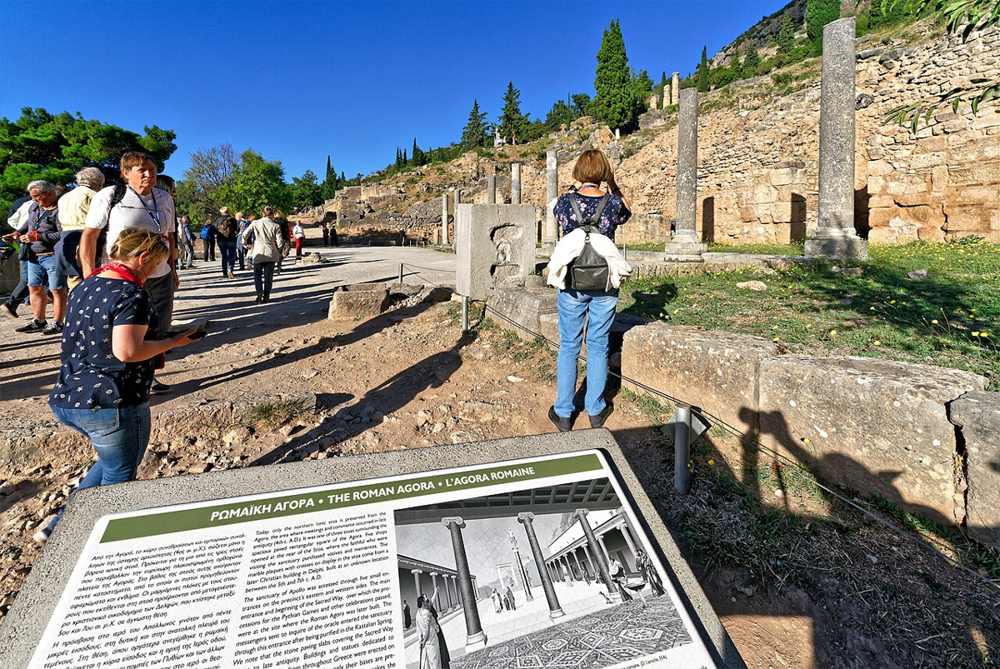
There are places in Greece that impress you with scale, and there are places that quietly rearrange the way you think. Delphi belongs firmly to the second category. Clinging to the steep slopes of Mount Parnassus, looking out over a vast sea of silver-green olive trees that rolls all the way down to the Gulf of Corinth, this was the spot the ancient Greeks believed marked the very center of the world. According to legend, Zeus released two eagles from opposite ends of the earth, and they met here. To commemorate the moment, a carved stone called the omphalos, the navel, was set down to mark the meeting point. Standing on the same terraces today, with the wind moving through the ravine and the rock faces of the Phaedriades glowing in the late afternoon light, it is surprisingly easy to understand why people once thought this place touched the divine.
For more than a thousand years, Delphi was the spiritual heart of the Greek world. Kings, generals, colonists, and ordinary citizens traveled enormous distances to consult the famous oracle, the priestess of Apollo known as the Pythia, whose cryptic answers could decide wars, found cities, and shape destinies. Today the oracle is silent, but the sanctuary remains one of the most atmospheric and rewarding archaeological sites anywhere on the planet. This guide walks you through what to see, how to reach Delphi from Athens, when to come, and how to make the most of a visit that, for many travelers, becomes the unexpected highlight of an entire trip to Greece.
The news portal Picantiko.gr tech covers news, technology, business and travel every day, giving readers clear, reliable and always up-to-date coverage from Greece and around the world.
Why Delphi Mattered: A Quick Sense of the Place
To appreciate the ruins, it helps to understand what once happened among them. Delphi was not simply a temple; it was an international institution. The Pythia delivered prophecies on behalf of the god Apollo, and her words carried weight across the entire Mediterranean. City-states sent lavish offerings to win favor and to display their wealth and piety, lining the Sacred Way with treasuries, statues, and monuments. The site was also the home of the Pythian Games, one of the great Panhellenic athletic and musical festivals, second in prestige only to the Olympics.
What makes walking through Delphi so moving is the layering of all this human ambition onto an already overwhelming landscape. The ancients chose the location with care. The mountain rises sharply behind the sanctuary, springs of fresh water emerge from the rock, and the valley below opens into one of the most dramatic panoramas in the country. The combination of sacred geography and accumulated art turned Delphi into a kind of museum of the ancient world even in antiquity, a place where the achievements of rival cities stood side by side.
The Sanctuary of Apollo and the Sacred Way
The main archaeological site is built around the Sanctuary of Apollo, and the journey through it follows the ancient Sacred Way, a zigzagging path that climbs the hillside. As you ascend, you pass the foundations of the treasuries, small temple-like buildings where individual cities stored their dedications. The most famous and best preserved is the elegant Treasury of the Athenians, partially reconstructed, with its crisp marble and carved decoration giving a real sense of how vivid these structures once were.
Read more: Αρνητικές Κριτικές Google για Τουριστικά Γραφεία
Higher up stands the centerpiece: the Temple of Apollo. Although what survives today is mostly the platform and a row of re-erected columns, the scale and position are unforgettable. This is where the Pythia sat to deliver her prophecies, and where the famous maxims of the Greek world, including the celebrated instruction to know yourself, were said to be inscribed. Take your time on this terrace. The view down the valley from the temple platform is one of the great rewards of the visit, and it is worth pausing simply to absorb it.
The Ancient Theatre
Just above the temple lies the ancient theatre, one of the best preserved features of the site. Carved into the slope, it once hosted dramatic performances and musical contests during the festivals. Its rows of stone seats sweep upward, and from the top tiers the perspective is spectacular, framing the temple, the valley, and the distant mountains in a single sweeping image. Climbing up here is one of the most photogenic moments of any Delphi visit, and it gives a vivid sense of how spectators experienced both the events and the scenery at the same time.
The Stadium
Continue the climb to the very top of the sanctuary and you reach the stadium, where the athletic events of the Pythian Games took place. It is remarkably intact, with stone starting lines, tiered seating, and the long flat track still clearly defined. Reaching the stadium requires a bit more effort, as it sits at the highest point of the site, but the reward is twofold: a beautifully preserved structure and a calmer, less crowded corner where you can imagine the roar of ancient spectators. Anyone who enjoys the quieter, more contemplative parts of a site should make the extra climb.
The Sanctuary of Athena Pronaia and the Tholos
A short walk along the road from the main entrance, slightly downhill and easy to miss if you are not looking, lies the Sanctuary of Athena Pronaia. This was the first sacred precinct that ancient visitors encountered as they approached Delphi, dedicated to the goddess who guarded the way to Apollo. Its standout monument is the Tholos, a graceful circular building whose three reconstructed columns crowned with a partial roof section have become the iconic image of Delphi, appearing on countless postcards and guidebook covers.
The Tholos is worth visiting for more than the photograph, however. The setting here is softer and greener than the main sanctuary, surrounded by olive trees and open to the valley, and it tends to be quieter. Many visitors rush past it, which means an early or late walk down to the Tholos can feel almost private. The elegance of the circular form, its mathematical harmony, and the way it sits within the landscape make it a perfect spot to slow down and reflect before or after exploring the busier upper site.
Read more: Μέτρηση Απόδοσης και ROI του AI SEO: Ο Πρακτικός Οδηγός
The Delphi Archaeological Museum
It would be a serious mistake to visit the ruins and skip the museum, which sits right beside the main site. Many of the finest objects discovered at Delphi were moved here for protection, and the collection ranks among the most important in Greece. Allow at least an hour, and ideally more, to take it in properly.
The undisputed star is the Charioteer of Delphi, a life-size bronze statue of breathtaking quality. Cast more than two and a half thousand years ago, it has survived almost perfectly intact, with inlaid eyes that still seem to hold a calm, otherworldly gaze. It is one of the greatest surviving bronzes of antiquity, and seeing it in person is a genuinely emotional experience. The detail of the figure, the texture of the garment, and the serene expression reward long, slow looking.
Beyond the Charioteer, the museum holds an extraordinary range of treasures, including:
- The twin archaic statues believed to represent the brothers Kleobis and Biton, among the earliest large-scale Greek sculptures.
- Fragments of the elaborately carved friezes from the treasuries, showing scenes of gods, battles, and myths.
- The omphalos stone, the carved marker that symbolized Delphi as the navel of the world.
- A magnificent sphinx that once stood atop a tall column dedicated by the island of Naxos.
- Votive offerings, inscriptions, and everyday objects that bring the daily life of the sanctuary into focus.
Visiting the museum either before or after the ruins helps the whole site come alive. Seeing the original sculptures and then standing where they once stood, or vice versa, joins the fragments into a coherent picture of what Delphi truly looked like in its glory.
The Castalian Spring
Between the Sanctuary of Athena Pronaia and the main site, tucked into a cleft in the towering Phaedriades cliffs, lies the Castalian Spring. In ancient times, pilgrims purified themselves with its waters before consulting the oracle, and poets later treated the spring as a source of inspiration. The setting is dramatic, with sheer rock walls rising overhead and cool water emerging from the mountain even in the heat of summer.
See also: Explore Delphi, Greece: Ultimate Guide to the Archaeological Site of Delphi
Read more: SEO Reporting: Πώς να Παρουσιάζετε Αποτελέσματα με Νόημα
Access to the spring area can sometimes be restricted for safety reasons because of the risk of rockfall, so it is not always possible to walk right up to the fountains. Even so, the location is worth seeing as you pass between the sites, and it adds another layer to the sense of ritual that once governed every approach to the oracle. If you do find it open, take a moment to appreciate the shade and the sound of the water, a welcome contrast to the sun-baked terraces above.
How to Get to Delphi from Athens
Delphi sits roughly a hundred and eighty kilometers northwest of Athens, and the drive takes around two and a half to three hours depending on traffic and stops. For most international visitors, Delphi is comfortably doable as a long day trip from the capital, though staying overnight in the area unlocks a far richer experience. There are several ways to make the journey.
Organized Day Tours
The simplest option for many travelers is a guided day tour. These typically depart Athens early in the morning, include comfortable transport, and provide an expert guide who brings the site and its myths to life. A good guide adds enormous value at Delphi, where so much of the meaning lies in stories and context that are not obvious from the stones alone. Tours usually cover both the ruins and the museum, and many include a stop in the mountain town of Arachova. The trade-off is less flexibility, since you follow a fixed schedule, but the convenience is considerable, especially if you would rather not drive on mountain roads.
Renting a Car
Driving yourself gives the greatest freedom. The route from Athens is straightforward, mostly on good roads, and the final stretch into the mountains is genuinely beautiful. Having your own car lets you linger at the site for as long as you like, time your visit to avoid the busiest hours, and explore nearby villages and viewpoints at your own pace. The mountain roads are well maintained but winding in places, so allow extra time and drive carefully, particularly in the cooler months when conditions can change quickly at altitude.
Public Bus
For budget-conscious and independent travelers, intercity buses connect Athens with the town of Delphi. The journey is scenic and affordable, though schedules are limited and the timing can make a same-day return tight. Taking the bus generally works best if you plan to stay overnight in the modern village, which sits a short walk from the archaeological site and offers a relaxed base with excellent valley views.
Read more: Media News Σήμερα: Πώς Αλλάζει Η Ενημέρωση, Η Ψυχαγωγία Και Η Εμπιστοσύνη Του Κοινού
Arachova and the Surrounding Area
Most journeys to Delphi pass through Arachova, a handsome stone-built town draped across the slopes of Parnassus just a few kilometers away. In winter it transforms into one of Greece’s most fashionable mountain resorts, drawing skiers to the nearby slopes, but it is charming in every season. Narrow lanes climb between traditional houses, small shops sell local woven goods and the region’s famous cheeses and honey, and the cafes and tavernas serve hearty mountain cooking that feels worlds away from the seafood of the islands.
Pausing in Arachova for a coffee or a long lunch is a perfect complement to a Delphi visit. The town’s elevated terraces offer sweeping views, and the slower pace provides a pleasant counterbalance to the intensity of the ruins. If you have extra time, the wider region rewards exploration too, from the monastery of Hosios Loukas with its glittering Byzantine mosaics to the green coastal plain around the Gulf of Corinth. Combining Delphi with one or two of these stops turns a single day into a memorable journey through the heart of central Greece.
Best Time to Visit and Practical Tips
Delphi can be visited year-round, but the experience varies sharply with the seasons. Spring is arguably the finest time of all. The hillsides burst with wildflowers, the temperatures are mild, and the valley below glows a fresh, vivid green. Autumn is similarly pleasant, with comfortable walking weather and softer light that flatters the marble. Summer brings reliable sunshine but also strong midday heat and the largest crowds, so an early start is essential. Winter has its own quiet magic, with the possibility of snow dusting the peaks and far fewer visitors, though some facilities operate on reduced hours and mountain weather can be unpredictable.
Whatever the season, the site is steep and largely uncovered, which means a little preparation makes a big difference. Keep the following essentials in mind:
- Wear sturdy, comfortable shoes with good grip, since the Sacred Way is uneven and the climb to the stadium is steep.
- Bring water, especially in the warmer months, as there is limited shade among the ruins.
- Pack sun protection: a hat, sunglasses, and sunscreen are invaluable on the exposed terraces.
- Carry a light layer even in summer, because the mountain air can turn cool and breezy, particularly at the higher levels.
- Arrive early in the day to enjoy the cooler temperatures and to walk the site before the largest tour groups appear.
- Allow at least half a day for the combined site and museum, and ideally a full day if you also want to explore the Tholos and Arachova.
It is worth buying a combined ticket that covers both the archaeological site and the museum, which represents good value and saves time. Check the current opening hours before you set out, as they shift between the high and low seasons and around public holidays. If you are not joining a guided tour, consider hiring a private guide at the entrance or using a quality audio guide or app, because the background stories transform a walk among ruins into a vivid encounter with the ancient world.
Read more: SEO Στην Αθήνα Σήμερα: Ο Πρακτικός Οδηγός Για Υψηλότερες Θέσεις Και Περισσότερους Πελάτες
Making the Most of Your Delphi Experience
Many visitors treat Delphi as a checklist of monuments to photograph, but the place rewards a slower, more thoughtful approach. Try to set aside time simply to sit, whether on the upper rows of the theatre, on the steps of the temple terrace, or beside the quiet Tholos, and let the landscape work on you. The ancients believed this site connected the human and the divine, and even the most rational modern traveler often feels something of that charge in the silence between the columns.
Pacing matters too. The natural rhythm is to begin with the Sanctuary of Athena Pronaia and the Tholos while the morning is still cool, then move up to the main sanctuary, climbing through the Sacred Way to the temple, theatre, and stadium, and finally to spend the latter part of your visit in the air-conditioned calm of the museum during the hottest hours. This sequence lets you match the demands of each part of the site to the conditions of the day, ending with the Charioteer fresh in your mind as you head back down the mountain.
Photographers should aim for early morning or late afternoon, when the low sun rakes across the cliffs and the marble takes on a warm golden tone. The light at midday tends to be flat and harsh, washing out the contours of the stone. If you have the luxury of an overnight stay in the modern village or in Arachova, you can catch both the dawn and the dusk, when the valley fills with mist or glows under the setting sun, and the crowds have melted away entirely.
A Final Word Before You Go
Delphi is more than a collection of ancient stones on a beautiful mountainside. It is a place where geography, myth, art, and history fuse into something that genuinely lingers in the memory long after you have left. Whether you come on a quick day trip from Athens or build a slower journey through central Greece with stops in Arachova and the surrounding villages, the sanctuary of the oracle has a way of exceeding expectations. Arrive prepared, give yourself enough time, and approach it with curiosity rather than a stopwatch, and the navel of the ancient world will reward you with one of the most profound and beautiful experiences that travel in Greece can offer.
Read More
Discover more from One Million Blogs:
- Which new iPhone will has the same layout and chipset?
- Gisele Bündchen Can’t Stop Wearing These Retro Jeans
- How to look thinner with styling
- What to Do While You Wait for Plumbing Emergency Service
- 9 things you should know about painting
About The Author